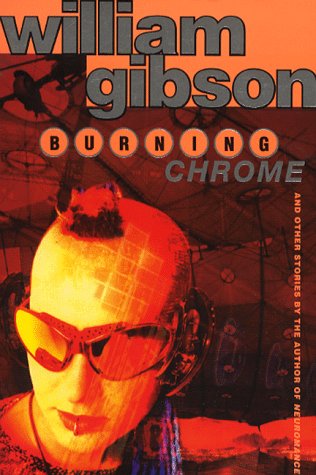
Choose a William Gibson short story such as Burning Chrome (see readings week 10). Compare the economic and social world it conjures with the imagined world of another cyberpunk author’s short story or novel (Neal Stephenson's 'Snow Crash.'). How close are these imagined worlds to our world and are we moving towards the imagined worlds or away from them?
And here it is:
Cyberpunk is a term coined by Bruce Bethke in 1982, and later popularised by science fiction editor Gardner Dozois (Encyclopaedia Britannica, 2011). It describes a wide genre, encompassing film, literature, art, and even music. The core concept behind all of these however, is the idea of a disillusioned loner on the edge of society, fighting a world that is increasingly technological and dehumanised. Many science fiction authors have written in the genre, among them household names like William Gibson, considered by many to have written the archetypal cyberpunk work with ‘Neuromancer,’ and Neal Stephenson, a relative newcomer to the genre. A common factor in all cyberpunk literature, including both Gibson and Stephenson, is the speculation of the technological, social, and economic situation that will be present in the future, evident through their novels. This essay will compare two cyberpunk works, ‘Burning Chrome,’ by William Gibson, and ‘Snow Crash,’ by Neal Stephenson, in terms of the social and economic futures predicted by the novels. This will then be compared with reality of the modern day, and as to whether these predictions are realistic.
The social futures typically presented by the cyberpunk genre are that of a dystopian society, generally in decline, with the advancement of technology disrupting society and the way the inhabitants of the society interact. This can be seen in both Burning Chrome and Snow Crash, with possibly the most important technological advancement in the novels – the Simulation Matrix, and the Metaverse. In Burning Chrome, the Matrix is “an abstract representation of the relationships between data systems,” a 3D virtual word in which the user is completely immersed (Gibson, 1986 p.196). The Metaverse, in comparison, is a 3D virtual world in which you can create or purchase your ‘avatar,’ and interact with other people in real-time. Property and advertisements, or ‘animercials,’ can be purchased using real money, in the virtual world. There is a blurring between life in reality, and life in the Metaverse.
This decline of society can also be seen in the way in which the physical society is structured in both novels. In Burning Chrome, the story is set in the Sprawl, a colloquial term for the Boston-Atlanta Metropolitan Axis, a huge megacity. In this representation of the future, space is at a premium, and virtually the entire East Coast of the United States has merged into one huge city. The majority of people are poor, but technology is easily accessible to all, allowing anyone to access the Matrix, or enjoy ‘simstims,’ a form of entertainment that allows people to experience a television program as seen through the eyes of the protagonist. Enhancements and augmentations to the body are also available, with the main character of the novel having a mechanised prosthetic arm, and other characters having eye augmentations, allowing them to record video through tiny cameras implanted in their eyes – the basis for simstim. In Snow Crash, society has disintegrated even further; governments and nations have broken down, and areas, armed forces, and even religions are owned by huge corporations, such as “Mr Lee’s Greater Hong Kong,” or “The Reverend Wayne’s Pearly Gates.” Universal laws and the justice system don’t exist; each corporation, or ‘franchise,’ has their own set of laws for their different areas, enforced by a private security corporation. As a result, crime isn’t necessarily wrong anymore - the Mafia operate in the open, as just another corporation. Society is dominated and controlled by corporations, and as such, money.
In the same way as society is generally portrayed as declining in the cyberpunk genre, the economy of these future times is usually just as grim, and is closely intertwined with the state of society itself. There is a large gap between the poor and the rich, and few in the middle ground. Technology has advanced, but the imagined ‘better life’ or ‘utopia’ that it would bring has fallen far short, a concept central to cyberpunk. In Burning Chrome, while technology and its benefits are available to anyone, irrespective of their financial status, the majority of citizens in the Sprawl just manage to scrape a living. Lower quality technology is available for a cheaper price, but it has serious side effects, as can be seen with the Seikon eye-implants. Apartments and living spaces are squashed together, and the population has skyrocketed. Snow Crash has a similar view of the economic future, in a system that can be described as ‘anarcho-capitalism.’ Governments and nations have collapsed, or are generally ignored, everything has been privatised, and hyperinflation has occurred, with “street people pushing wheelbarrows piled high with dripping clots of million- and billion-dollar bills that they have raked up out of storm sewers” (Stephenson, 1992 p.146) Space is also at a premium, with people (including the protagonist) living in shipping containers, or regimented identical housing estates. There is just as great a distinction between rich and poor, and society; religions, roads, housing, land, justice, and defense, are run entirely by corporations and businesses, all competing. The line between reality and the Metaverse has blurred, and money can be made through the virtual world, and vice versa, with the sale of land, avatars, and entertainment.
Aspects of the societal and economic futures predicted in both cyberpunk novels are certainly possible in reality both in the future, and today. In terms of technology – the worlds presented in both these novels are either already possible, or well on their way. Car HUDs on windscreens, Virtual Reality worlds, the Matrix, more advanced computers and devices – it’s just a matter of time, as our own level of technology rises. In terms of the social and economic futures presented, it’s less certain. It’s true we are withdrawing, communicating more through technology and becoming increasingly isolated, despite having more connections than ever before (Fox, 2010). Facebook can be seen as a primitive form of the Metaverse, while the internet itself is similar to both the Metaverse and the Matrix. We spend most of our time using it, either for entertainment, communication, or work. It is a medium through which you can become someone else, do things you couldn’t in real life – and things you could. Money can be made through it, despite the fact that it doesn’t physically exist. The economic future presented by both novels, can also be seen in today’s world, albeit to a lesser extent. Our world population is rising, corporations have more power and money than some governments, the gap between rich and poor is broadening, and technology, while advancing, is also becoming cheaper and more available (Deen, 2005; Sarno, 2011; AP, 2008). While this technological advancement has huge benefits for some, we are increasingly moving closer towards the dystopia of the cyberpunk future: the failed promise that technology will make life better for everyone.
References
- Associated Press, 2008, ‘Study: Gap growing between rich and poor,’ viewed 20 October, at http://www.msnbc.msn.com/id/27295405/ns/business-world_business/t/study-gap-growing-between-rich-poor/
- Deen, T 2005, ‘Rising population threatens global security,’ viewed 19 October, at http://www.un.org/special-rep/ohrlls/News_flash2005/08%20July%20rising%20population.htm
- Encyclopædia Britannica 2011, ‘Cyberpunk,’ viewed 11 October, at http://www.britannica.com/EBchecked/topic/147816/cyberpunk
- Fox, M 2010, ‘New health policy: encouraging friendships?’ viewed 20 October, at http://www.reuters.com/article/2010/07/27/us-lifespan-relationships-idUSTRE66Q6KA20100727
- Gibson, W 1986, ‘Burning Chrome,’ Harper Collins: Great Britain, London.
- Sarno, D 2011, ‘Apple has more cash than US government,’ viewed 19 October, at http://www.smh.com.au/technology/biz-tech/apple-has-more-cash-than-us-government-20110801-1i6x6.html
- Stephenson, N 1992, ‘Snow Crash,’ Bantam Books: New York
So there it is! I didn't post much up in the preceeding weeks, because a lot of the research required was just reading the two novels being compared. That, and the facts in the conclusion.
I hope you enjoyed it!